


Curatorial Culture
Curatorial Consciousness in the Times of Post-Nationalism
1 Vishakha N. Desai, ed., Asian Art History in the 21st Century (Williamstown, MA: Sterling and Francine Clark Art Institute, 2007).
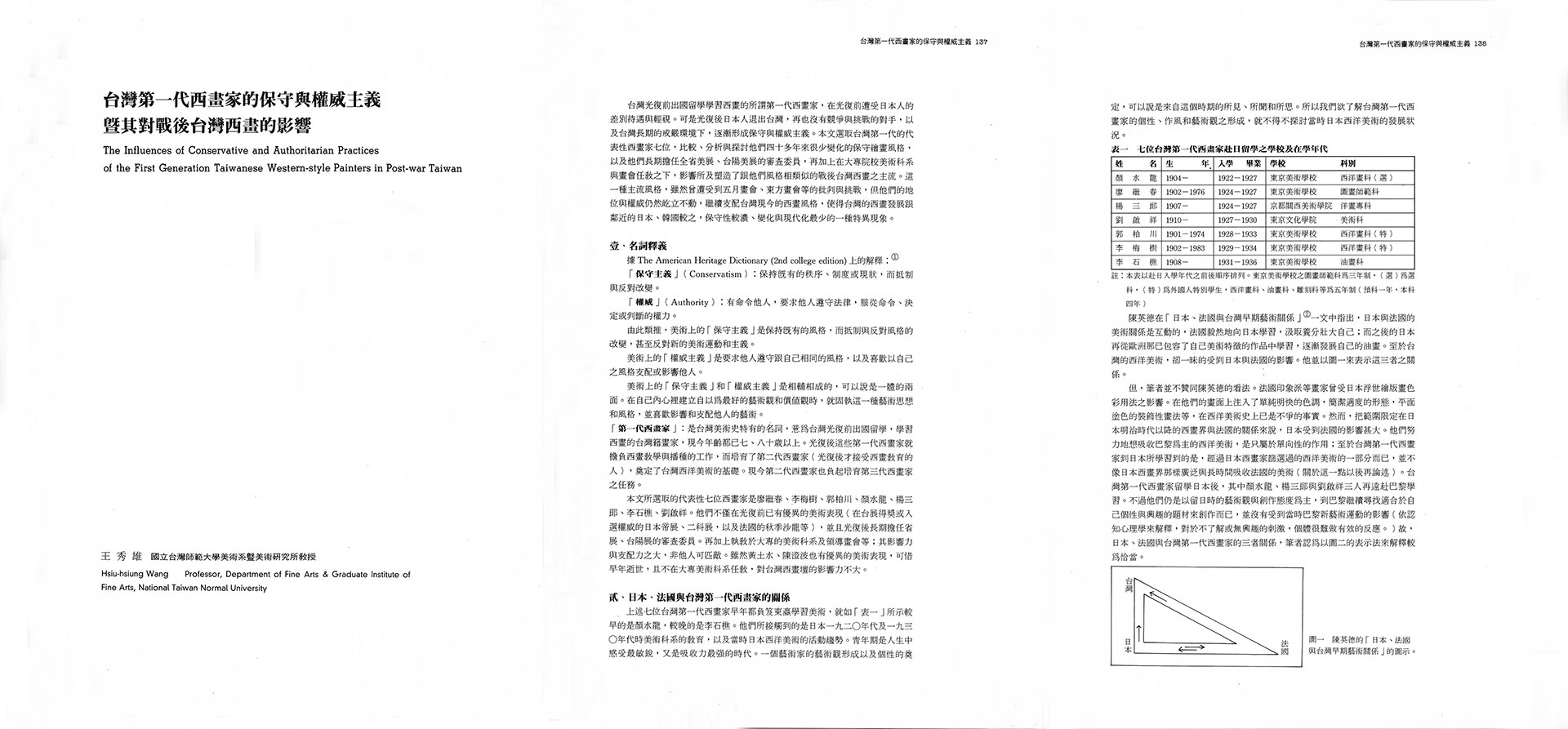
The Conservatism and Authoritarianism of the First-generation Taiwanese Painters and Their Impacts on the Post-war Western Painting in Taiwan writtenby Xiou-Xiong Wang. (Image Courtesy of Taipei Fine Arts Museum)
Art history’s global turn has by no means been a boon for non-Western territories. One must remain vigilant as to its underlying premises: (1) strategies for normalizing difference; (2) the prospect of art history as a parochial discipline with aspirations for global relevance; and (3) art history’s internal entanglements with European national consciousness and colonialism. Global art history to some degree represents the total triumph of the dark side of globalization, a homogenization of world culture.6 Many critics have however pointed to the fact that “statehood” has continually been brought up as a subject for discussion in regional contemporary art.
The methodology of a colonialist art history has been found floundering in the post-colonial era. Writings on regional or local art histories do not merely orient themselves towards critiques of Western art history. Early Taiwanese art criticism has always been a force to be reckoned with. Lin Xing-yue’s book Forty Years of Taiwanese Fine Arts for example (published by the Independence Evening Post, which was founded after the lifting of press restrictions after the end of martial law) did not mince words in its faithful descriptions of inter-generational controversies. Xie Li-fa, in the preface to the second edition of his book The Art Movement History of Taiwan under the Japanese Colonial Rule, expressed his awareness of and reflection on historiography. Xiou-Xiong Wang, in his essay entitled The Conservatism and Authoritarianism of the First-generation Taiwanese Painters and Their Impacts on the Post-war Western Painting in Taiwan, lambasted the authoritarianism reflected in Taiwanese artistic practice after the end of World War II.7
6 Chika Okeke-Agulu: Globalization, Art History, and the Specter of Difference, in
7 Xing-Yue Lin: Forty Years of Taiwanese Fine Arts , Taipei, Independence Evening Post , 1987. Li-Fa Xie:The History of the Taiwanese Art Movements during the Japanese Occupation , Artist Publishers,5th edition, 1998. Xiou-Xiong Wang, “The Conservatism and Authoritarianism of the First-generation Taiwanese Painters and Their Impacts on the Post-war Western Painting in Taiwan,” in A Discussion of the Historical Development of Taiwan’s Art (Taipei: National Museum of History, 1995), pp. 174-179.
In addition to the writing of local art history, Taiwan’s art historical practice in the 1990s clearly articulated deep concerns and high expectation for contemporary art, and even directed fierce criticism towards established institutions. The 1996 Taipei Biennial, The Quest for Identity, was an exhibition on Taiwanese art’s subjectivity, which drifted astray of the mainstream of internationalist biennials. Full of vitality and value, the exhibition exacted a holistic view and attempted to confront history and the present. Such an effort absolutely deserves our re-evaluation.
It is heartening to see momentum towards the production of discourse along the axis of curatorial practice. Chiang Po-Shin’s article The Contemporariness of Material: An Investigation Centred around the ‘Exhibition of the École de Seoul’ not only traces a path of Taiwan’s exhibition history, but is also an example of Inter-Asia studies and the mobility of art. In addition, if the crisis of art history rooted in colonialist concepts was believed to give birth to visual studies, we may as well argue that Goldsmiths’ College, a leading institution for curatorial education, has established a new curatorial paradigm. Moreover, ALTERing NATIVism by TheCube Project Space, Nobuo Takamori’s recent curatorial practice, and Lee UFan as a node in the 2019 Asian Art Biennale all served as alternatives to the thus-far description-based discipline of art history. As with the biennales in Havana, Dakar, Johannesburg, Istanbul and Gwangju, these attempts can also be construed as pioneering initiatives against the dominance of Western art history. The challenge we must take up today is to simultaneously consider all regions, nations, religions and global contingencies when engaging in debates concerning issues of history of Asian or Taiwanese art. The formal language of the exhibition indeed makes it possible for us to meet this challenge.
6 Xing-Yue Lin: Forty Years of Taiwanese Fine Arts, Taipei, Independence Evening Post , 1987. Li-Fa Xie:The History of the Taiwanese Art Movements during the Japanese Occupation , Artist Publishers,5th edition, 1998. Xiou-Xiong Wang, “The Conservatism and Authoritarianism of the First-generation Taiwanese Painters and Their Impacts on the Post-war Western Painting in Taiwan,” in A Discussion of the Historical Development of Taiwan’s Art (Taipei: National Museum of History, 1995), pp. 174-179.
7 http://curatorsintensive.tw/david-teh