


Curatorial Culture
The last decade has seen questions arise concerning the phenomenon of artistic research, and how it has played a meaningful role within educational environments, from art academies to exhibition spaces. To answer these questions in more detail, this essay will draw on four recent research projects to explore the perspectives both of institutions of higher learning and those currently engaged in exhibition-making.
Today, art education is haunted again and again by two persistent misconceptions. First, the conception of art as an irreflective, spontaneous and intuitive practice is still prominent, not only outside the institutional walls of the academy, but also inside those walls. This has created a situation, in which various approaches, perceptions and temporalities have come to co-exist within the current academy – sometimes overlapping, sometimes completely a-synchronous and antagonistic. A single institution may contain, for example, both a modernist studio model for fine arts education and a deconstructionist course track that views art in terms of “after images.” Secondly, research is often imagined as a tool by which to offer some sort of discursive support for a not-yet-articulated practice.
From the above, it follows that for the sake of an utterly necessary institutional emancipation, research should reposition itself as a fundamental and equal component of artistic practice. It should exist as a component of art, manifesting itself in artists’ reflections on how to devise questions, trajectories, and concepts that may give rise to their work.
Deliverables are sets of pre-determined, modularized, measurable, controllable outcomes. The very concept is related to the instrumental logic of our efficient, result-driven culture and its neoliberal focus on free market mechanisms. Such thinking supports a flat worldview that, as Byung-Chul Han described in Fatigue Society, continuously demands transparency and visibility – and therefore, forms of exhibition. It thus produces a horizontalist world that, with its Twitter-democracy and the ubiquitous blogosphere, brings a “net culture” into being that leaves no room for rest, contemplation, creation or experiment. Such a world is carried away entirely by entrepreneurial thinking and a focus on the contemporary moment, in which adaptivity and flexibility are elevated as supreme values. In short, it is a world without room for verticalist perspectives (like reflexivity), new modes of imagination, or historic profundity—perspectives which are characteristic of and fundamental to the academy.
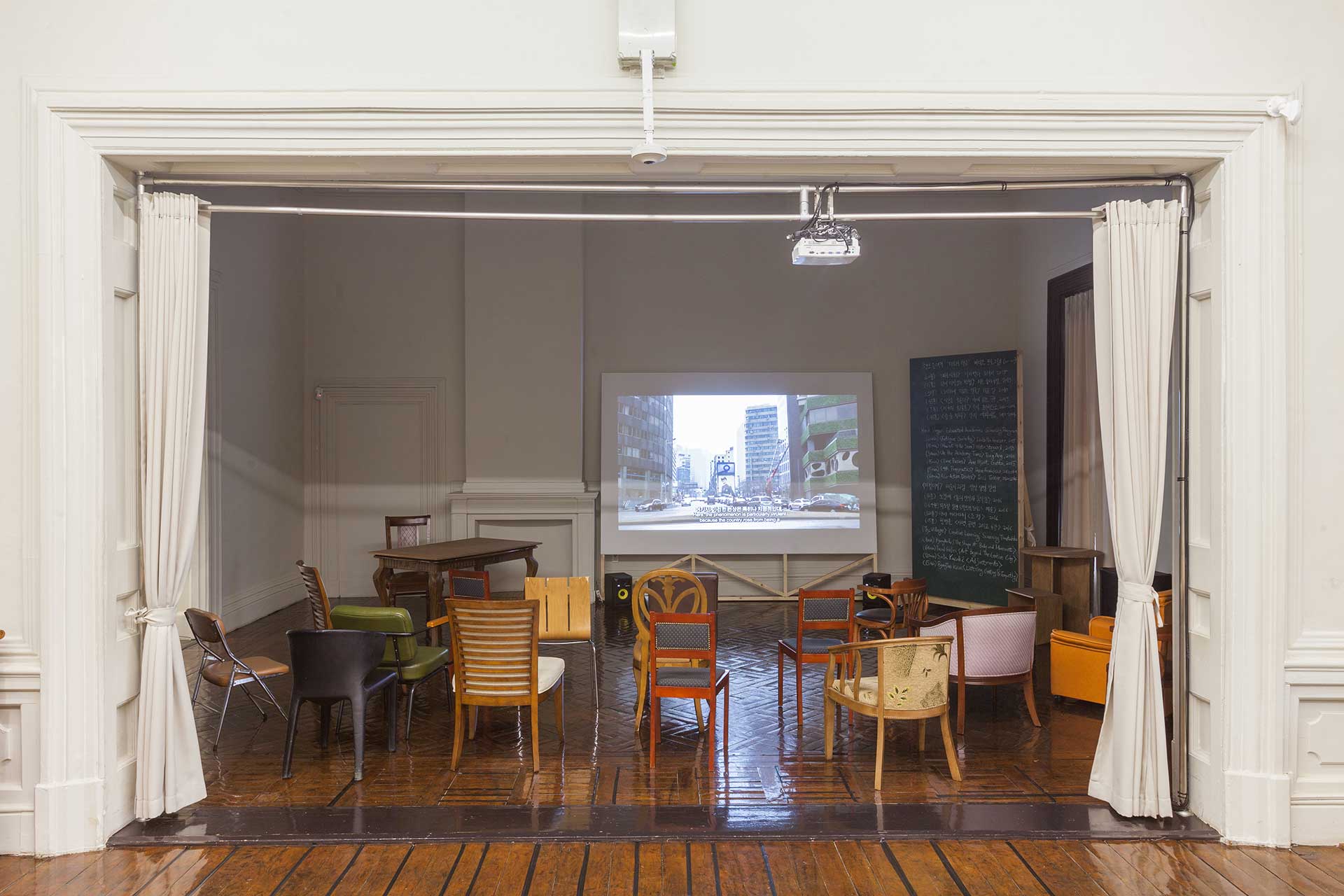
Installation view Exhausted Academies: Fatigue Society, Byung-Chul Han, Seoul Media City, 2016. © Photo: Seoul Museum of Art
1 The research project Exhausted Academies was presented in Seoul Media City (2016) and Nottingham Contemporary (2017), with contributions from Tiong Ang, Inci Eviner, Rene Francisco, Byung-Chul Han & Isabella Gresser, Hito Steyerl, Ane Hjort Guttu, and Muntadas. www.artandeducation.net/announcements/143995/doing-deceleration
2 Cf. Irit Rogoff, Practicing Research/Singularising Knowledge, in Agonistic Academies (ed. Jan Cools and Henk Slager, Sint Lukas Press, Brussels 2011). www.e-flux.com/announcements/35514/book-launch-agonistic-academies/
Owing to the inseparable connection between the making of art and the act of thinking, research must somehow be present in the intermediate processes of interconnection and translation. This means that research must be conceived as an oscillating translation, in which the material and immaterial continuously merge into one another, and in which dialogical activity focuses on dynamic processes. Such a pursuit may be characterized as performative3, precisely because the emphasis is not on production of an end product or of its reception, but on actions taken out of a sense of urgency, which seek to challenge the status quo by creating alternative—or even speculative—propositions. The power of this lies in the fact that artistic processes are considered as if from within, and therefore are able to articulate an ultimate claim for a different perspective on reality.
Given the numerous theoretical perspectives one may draw from, the study of the discursive dimension of an individual’s creative process—in many curricula referred to as “artistic research”—should preferably be offered in “seminars.” These seminars however should not focus on simply repeating canonized knowledge—as is characteristic of academic institutions with fixed curricula and clearly separated disciplines, which have degenerated into mere teaching machines—but instead, as in my Roland Barthes-inspired curatorial project To Seminar4, they should address the creation of an experimental laboratory by way of the de-institutionalization of the educational matrix. And they may thus create a non-disciplinary, affective environment, in which students may potentially become artists.
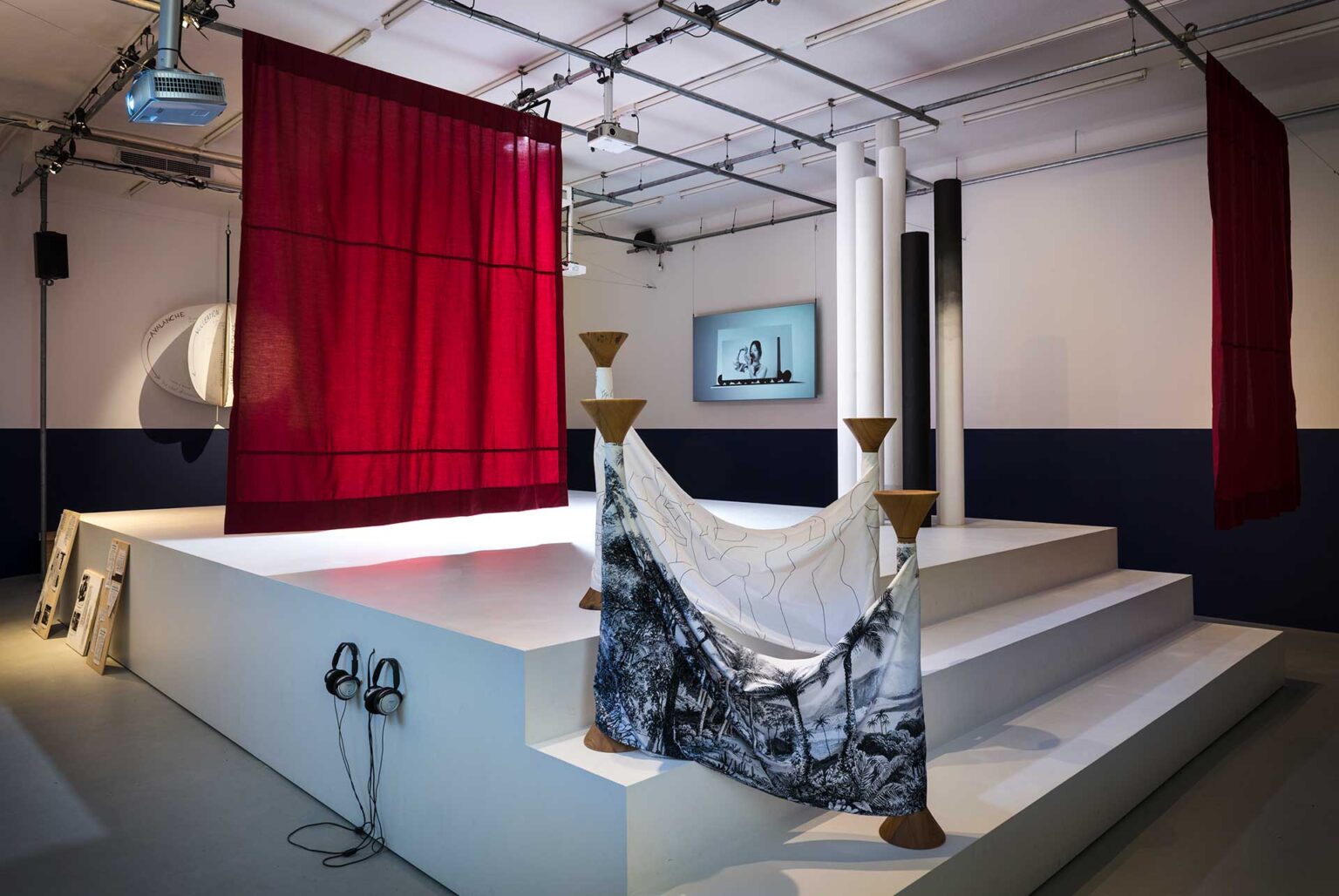
4 Cf. the curatorial project To Seminar that I curated in 2017 at BAK, Basis voor Actuele Kunst, Utrecht. This project unfolds as a contemporary reading of philosopher Roland Barthes’ essay “To the Seminar” (1974). Engaging with the notion of the seminar – as a concept and as an intimate and complex practice – as something pivotal for learning today, To Seminar transforms the word “seminar” from a noun into a verb in an attempt to activate its “unpredictable rhythm,” proposing it as a tool for intervention into the settled practices of education today, both in art and beyond. For what was once celebrated as the “educational turn” today turns far too often into either routine initiation into a knowledge economy or cognitive capitalism, or into the placatory emptying of the meanings of “knowledge production,” “community,” and “method.” If, like the era of Barthes’ writing, ours is a present immersed in “a certain apocalypse in culture,” the true task of learning is not to normalize this present’s morbid symptoms as has become customary, but rather to collectively think through and act out alternative imaginaries. With artists, theorists, and other cultural practitioners, To Seminar reengaged the three conceptual spaces that intersect when a seminar takes place – institution, transference, and text – and sought to recompose them into a balanced comradeship for renegotiating the conditions of the contemporary. www.artandeducation.net/announcements/142277/to-seminar
Up to the present, the academy has been the pre-eminent institutional environment for “doing research”5. Since its foundation, it has defined itself by inter-esse, or intellectual curiosity, and excluded oikos, or calculating reason. Now, despite the threat of increasing instrumentalization, quantification and disciplinary division, and despite the hollow rhetoric of the creative industry and its cognitive capitalism—which manifests itself in homogenizing patterns of thought, such as expert knowledge, knowledge transfer, stakeholders, employability, assessment and quality assurance, which try to reduce art education to a neoliberal dispositive—the academy still seems to be the last enduring free space in the cultural field for giving rise to innovative and experimental processes of production, reflection and presentation. The academy should continue to fight for this kind of temporary, autonomous space for experiment and reflection. Such a space could thrive through the combination of various forms of knowledge into new speculative ensembles.
5 The curatorial project (workshop, symposium, publication—curated by Jan Kaila and Henk Slager) Doing Research—in which research within and outside of institutional settings was expounded—took place as part of dOCUMENTA 13, 2012. www.artandeducation.net/announcements/109237/doing-research
Thus, an educational environment could emerge that no longer exclusively focuses on the repetition of canonized knowledge, fixed curricula and clearly separated disciplines, but also addresses the creation of experimental seminar environments, which may be characterized by forms of open-ended, non-hierarchical, and speculative thought.6 Such environments could generate—in spite of the current technologies of distraction—a space for differing intelligences and unconventional sensibilities, which enables students as future artists to imagine anew the world and how we relate to it.
6 In the curatorial project Whatever Speculation (2019), the question of the position and situation of the concept of “Speculation” is again raised. www.mahkuscript.com/4/volume/3/issue/1
A screening related to this project took place at OnCurating in Zurich: https://oncurating-space.org/re-imagining-futures
The first decade of the 21st century was characterized by a disproportionate interest in the production of knowledge. Consequently, many artists started to view the act of artistic creation as process-oriented and rigidly determined by a series of points of departure or deliberation, which seemed to steer the making of art. Increasing academization—which is to say, the willingness to comply with those formatting requirements imposed on the production of knowledge by the institutional apparatus—appears to underline this tendency. For this reason, it now seems more urgent than ever to return our attention to what precedes knowledge production, i.e. the process of thinking, a thinking that has been a bond between philosophy and art since time immemorial.7 Precisely in this dialogue with philosophy, artistic thinking may return its attention to not-knowing, the singular, the affective, the transgressive, and the unforeseen.
7 Such an approach is the starting point of my book The Pleasure of Research (Hatje Cantz, Berlin 2015). This publication delves into issues such as knowledge production, artistic thinking, medium-specificity, and context-responsiveness. How do these issues connect to the current state of art education and artistic research? The Pleasure of Research argues that artistic research should foreshadow a “gaya scienza,” a temporary autonomous activity where intellectual pleasure and an experimental method invigorate forms of research and thought. www.e-flux.com/announcements/29650/hatje-cantz-publication-the-pleasure-of-research
Moreover, Arendt explicitly presented her act of thinking in a public space as a performative act to demonstrate it as a form of engagement. And thus, as Hito Steyerl argues8, this form of thinking is primarily situated in the tradition of emancipatory struggles, which Peter Weiss described as an Aesthetics of Resistance—a form of thinking that demands room for public debate vis-à-vis institutional disciplines and standardization and the formulation of topical values and truths. Where necessary, it may even dare to make judgments that run counter to the regulatory registers of cognitive capitalism and symbolic labor.
At stake here is a radical manner of resistance based on the intrinsic potential of art to imagine the world differently—a speculative and associative form of open-ended thinking that looks towards the unknown, and thus withdraws from deterministic and causally inspired models of thought. In short, it is a form of thinking that cannot be caught in static, pre-formed categories and that will ultimately contribute to what Foucault described as a “new aesthetics of existence.” Subsequently, research should be understood as a verb and certainly not as a noun (i.e. a deliverable to be presented as a final product). The point of emphasis here is that artistic research should not be ossified within an institutional architecture of distinctly defined inquiries, but should rather remain linked to the dynamic concerns and urgencies put forth by artists.
Artistic research—owing to its provisional qualities—may therefore best be described as a transpositional framework, a non-disciplined space in which collections of creative practices, artistic thinking processes and curatorial strategies continually produce new sets of relationships. These idiosyncratic combinations in turn contribute to the articulation of urgent, planetary issues.
8 Hito Steyerl, Aesthetics of Resistance, MaHKUzine 8, Winter 2010, Utrecht, pp. 31-37. https://issuu.com/hku-online/docs/mahkuzine08_web
Moreover, artistic research as a field of inquiry—as presented in the 3rd Research Pavilion (Venice Biennale, 2019 entitled Research Ecologies9—outlines at the same time its own methodological and epistemological preconditions. Artistic research may be characterized by uninterrupted, transversal interaction and the articulation of three inseparable and intrinsically interconnected lines: the line of creative practice, the line of artistic thinking, and the line of curatorial strategy.
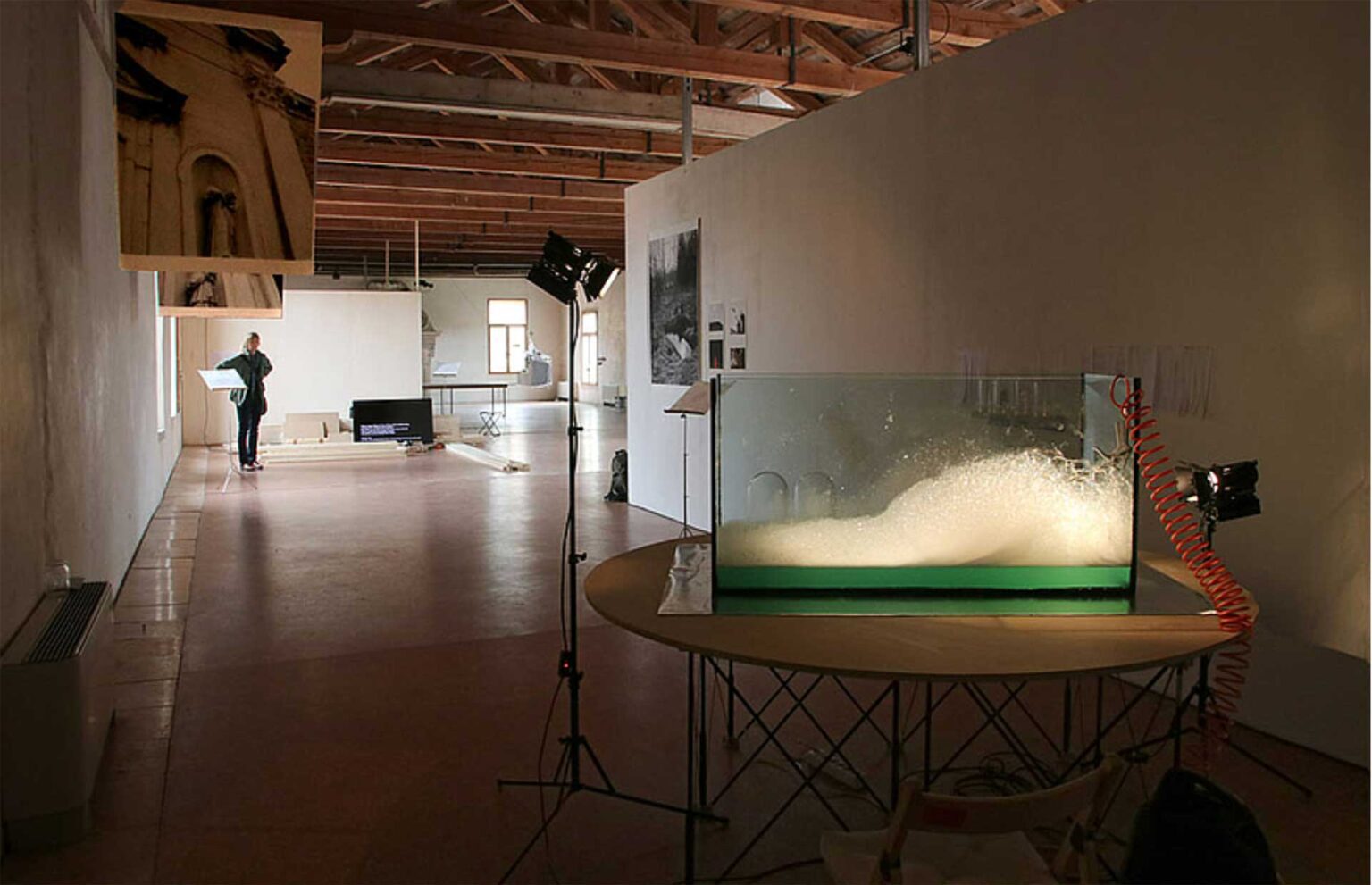
In the curatorial project Farewell to Research (9th Bucharest Biennale, 2021), these three lines will be further situated as departing from the perspective of the assemblage 10. This will offer a critical view on the rhetorical impact of an over-emphasis of any of these three lines—creativity, artistic thinking, or curatorial strategies—on our current understanding of the concept of research.
Thus, the proposed project furnishes a distinct impetus for the reclamation of creativity—a concept that, owing to its intrinsic quality of freedom, seems nowadays hostage to the one-dimensional rhetoric of the protocol-oriented creative industry, but in fact it should stand for exploring the potential of the sensible through the making of art.
These are approaches that —in line with Guattari’s agenda-setting Three Ecologies—ask again for ethico-political statements. After all, we suffer from a loss of common orientation or a common world. To think again about this world we desperately need another system of coordinates, another distribution of metaphors and sensitivities: new fictions and imaginaries to address the constituencies and configurations of the present and speculate about the future. Here are some significant challenges for artistic research: developing new theoretical and artistic representations of novel modes of interconnection between human and non-human actors and factors; articulating new modes of thinking and representing the global environmental crisis; and related to this last point, addressing issues of historical responsibility. www.researchpavilion.fi
The specificity of artistic research—an activity that is entirely determined by vital encounters between creative practice, artistic thinking, and curatorial strategies—somehow remains (and this is exactly what the curatorial project Farewell to Research intends to explore further by means of a series of presentations and discussions) unequivocally embedded within art, while at the same time articulating questions, raising doubts, and most of all creating novel, future-oriented ideas.
10 In using such a characterization, the 9th Bucharest Biennale (Farewell to Research, 2020-2021, curator Henk Slager) sets itself at a clear distance from those misconceptions that have accumulated around the concept of artistic research over the past decade. These misconceptions seem to reduce research in the arts to a noun, whereas the above-described dynamics and related provisional qualities rather demand the dynamics of a verb. But above all, these misconceptions seem to result from the absolutization of one of the three—intrinsically and inseparably connected —lines.
Although the main issue here obviously is imagining the world in a different way, which implies new future-orientated modes of political imagination, one should not equate the perspective of the curatorial line to political activism—just as one should not reduce the line of creativity to product innovation research, or the line of artistic thinking to pseudo-scientific research.
The potential of artistic research lies—as the project Farewell to Research emphasizes—in ‘thinking differently,’ i.e. a way of thinking that demonstrates how we may shift from planning to speculation. This is an associative form of open-ended thinking that alludes to the unknown and thus withdraws from deterministic and causality-inspired models of thought. Documentation in progress: www.mahkuscript.com/5/volume/4/issue/1
Share
Author
As Professor of Artistic Research (Finnish Academy of Fine Art 2010-2015) and as Dean of MaHKU Utrecht, Henk Slager has made significant contributions to the debate on the role of research in visual art. In 2006, he co-initiated the European Artistic Research Network (EARN), a network investigating the consequences of artistic research for current art education in symposia, expert meetings, and presentations. Departing from a similar focus on artistic research, he has also (co-) produced various curatorial projects, a.o. Translocalmotion (7th Shanghai Biennale 2008), As the Academy Turns (Collaborative project Manifesta, 2010), Doing Research (dOCUMENTA 13, 2012), Offside Effect (1st Tbilisi Triennial), Timely Meditations (5th Guangzhou Triennial, Asia Time, 2016), To Seminar (BAK, Utrecht 2017), Research Ecologies (3rd Research Pavilion), and Farewell to Research (9th Bucharest Biennale 2021). He recently published The Pleasure of Research (an overview of educational and curatorial research projects 2007-2014), Hatje Cantz, Berlin 2015.