


Curatorial Culture
Debates on the notion of the curatorial and its related exhibition practice have been going on for more than a decade. Curators and scholars often contrast “the curatorial” with “the curating” (Jean Paul Martinon, Beatrice von Bismarck, Irit Rogoff, et al.). Maria Lind’s publication reiterates such a distinction in describing the curatorial as a presentation, and curating as representation.1 Such a dichotomy prescribed by many can certainly go against the grain of Herald Szeeman’s assertion that a curator is merely an “exhibition-maker (ausstellungsmacher),” a practical wisdom in making art public. For me, there is some beauty in Szeeman’s statement, such that an exhibition-maker could treat curating as a poetic device and to render the creative aspect possible, precisely because of the involvement of poiesis, or the making of becoming. The curatorial can overlap with curating in some areas, although the former often emphasizes philosophical and ethical approaches of reflexivity, self-criticality, and knowledge production. Can the representation aspect of curating include the presentational? Or, who will be the presenter of such presentation belonging to the curatorial? The list of questions drawn from this pair of concepts can go on and on. This article will focus on the moot point of curating versus the curatorial, by pushing the binary operation to bring forth what can be the “thing-ness” of curation.
A democratic situation of curatorial event ought to bring out the special form of the political, as Jacques Rancière calls attention to meta-politics where the emancipated spectatorship along with an autonomous aesthetic experience happens. Usually the moment of epistemological un-decidability is prescribed for the spectators as the curatorial concern, which cannot be equated to a certain representation of demos in mirroring the antagonistic situation of democracy. Even if a political reality is presented by an exhibition, e.g., Occupy Wall Street in Documenta 2012, the political aspect still needs to be read as an artistic expression and be aesthetically experienced. The political in art apparently is unique and cannot be equated to the political in the social domain. However, I am not against the instrumentalization of art. Such function of art can only serve as the by-product that takes as a part of textual content the work, which matters the most. Taking political art for example, I do believe the “art” part is much more important than the political one. Social-engagement art that often involves participation of communities creates layers of spectatorship, those who collectively making work with an artist and those who refers as the representation of a certain social group or class, which altogether are indispensable part of the work. In a curatorial event the usual unnoticeable spectators and beholders are the ones who can be easily ignored; they are demos of art exhibitions.
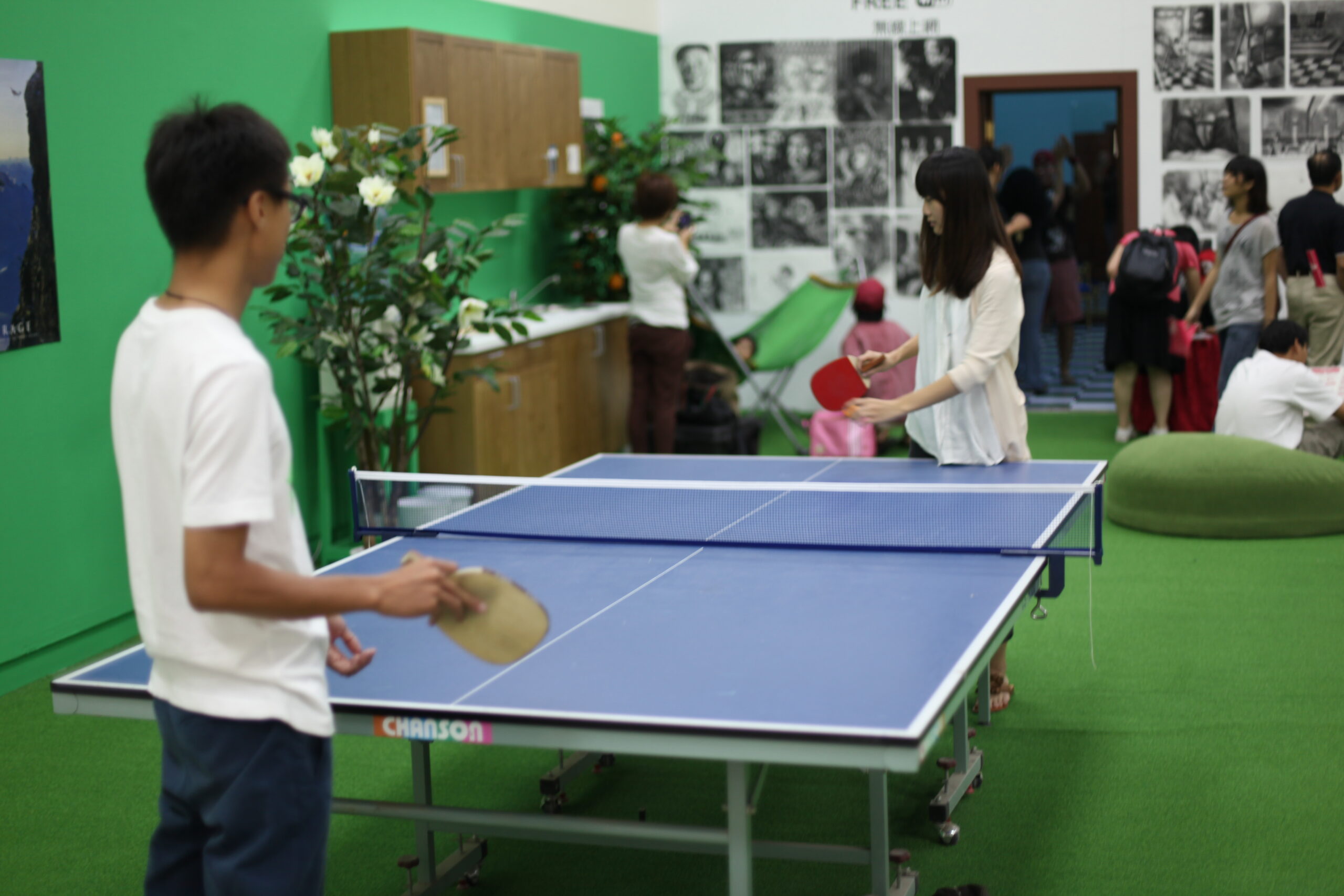
Olivia Plender, Google Office, Taipei Fine Arts Museum, 2010. (Photo: Hongjohn Lin)
In fact, Curatorial Things shares not only different types and techniques of curatorial practices, namely the performative and institutionalism, which together are based on a self-reflexive stance in thinking what a curating can be. Performative curating grows out of J.L. Austin’s speech act theory, always plays around the discursive practice and enacts a reality effect. The performativity in exhibition means to take action to reveal their inner logic of cultural representation. Through the consideration of presentation in relation to events, participation, and actions shows the way in which truth and knowledge are being constructed and how histories are generated. In short, the performative shows the backstage of how realities are constructed. The performative denaturalizes an exhibition by resetting the dynamics among acting and enactment. The conventional scripts of an artist, a spectator, and a curator are rewritten, and therefore the symbolic order is disrupted to show the construct of the reality in exhibition.
In addition, these curatorial things include the status of art objects that are essentially relics, artifacts, works of art, those which are displayed in museums in reflection of their the origins and destinies. The conception of museums grows out of the project of colonialism and nationalism, and most things are changed from their original functions to the status of art, which in turn becomes the trophy of national pride, and the signifier of a collective identity. Things collected from ethnographical exploration are stolen from other cultures, an instrument to exclude others. A museum is a “sematic monster,” capable of coding cultural messages for things in exhibition. Not to mention, the architecture of museum itself as a thing has ready manifested a prestigious cultural statement in housing the high-art treasure.
Within a decade, another curatorial thing also includes the notion of das Ding, namely the assembly, in organizing occasions for public affairs, res publica. Bruno Latour’s neologism, Dingpolitiks, invites participants in gathering public discourses. Without sacrificing to any pre-given political thoughts, the Dingpolitiks creates public concerns and negotiates public matters in a way that responds to Heidegger’s appropriation of the Germanic legal term. Latour promotes the shaping of the public engagement in exhibition:
In fact, Curatorial Things shares not only different types and techniques of curatorial practices, namely the performative and institutionalism, which together are based on a self-reflexive stance in thinking what a curating can be. Performative curating grows out of J.L. Austin’s speech act theory, always plays around the discursive practice and enacts a reality effect. The performativity in exhibition means to take action to reveal their inner logic of cultural representation. Through the consideration of presentation in relation to events, participation, and actions shows the way in which truth and knowledge are being constructed and how histories are generated. In short, the performative shows the backstage of how realities are constructed. The performative denaturalizes an exhibition by resetting the dynamics among acting and enactment. The conventional scripts of an artist, a spectator, and a curator are rewritten, and therefore the symbolic order is disrupted to show the construct of the reality in exhibition.
Indeed, the museum has been a site for public assemblies since the 18th century, and an exhibition is always by definition a public event. In exhibition to response Dingpolitik, the role of spectators and beholders can turn themselves into active participants in voicing the public discourse, which are also undeniable a representation of certain groups and divisions. The presentation of representation for participating groups can be highlighted, instead of the common public as spectators. Furthermore, the agenda of such public assemblies are planned beforehand, and it was not formed automatically.
More importantly, in presenting the assembly of negotiations, the exhibitions have transformed themselves from a site of public contemplation, which belongs to the aesthetic domain, to a site of public discussion that is still not necessarily political antagonism. If the curatorial includes dingpolitik, then the validity of representation to the public sphere needs to be considered as the exhibition displaces from the autonomous aesthetic to the heteronomous social domain.
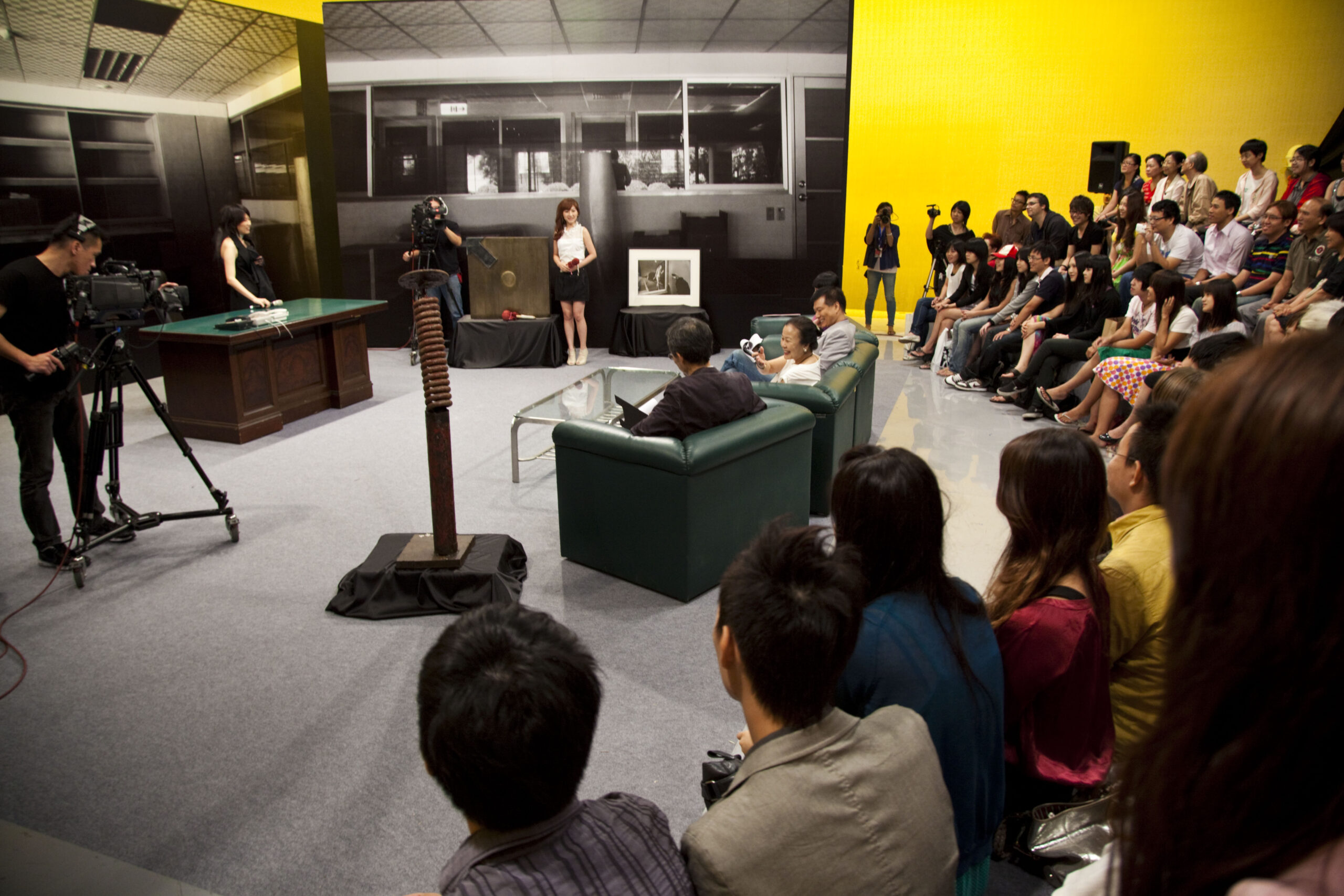
Christian Jankowski, Director’s Cut, Taipei Fine Art Museum, 2010. (Photo: Hongjohn Lin)
Among these curatorial things—the assembly, the collection, and the curating practices, there are apparently two levels of things in the curatorial: the first one is a literal thing, an object that in everyday usage of language that signifies a work of art. The second is about various curatorial practices framed by different exhibition contexts of museums, art fairs, or biennials in signifying what art can do. In these two levels, both involve the space-time relations—namely the history, locale, and site—in a combined determination of such tradition, to which the things truly belong, instead of some happenings of random incidents. These things can be matters of attention when they are damaged or endangered as they become noticeable, precisely in Heidegger’s term “present-thing-at-hand,” the presence of once naturalized objects. These curatorial things are on the way to be considered as the ground and basis, and there should be the thingness, the curatorial thing, to be addressed.
There are at least three parallel definitions of the word care, which appears to be ambiguous and even contradictory. As we noted earlier as in Flowe’s undertaking, to care usually means to be responsible for or attend to health, well-being, welfare, and safety. The other one is about solicitude, and it also had connotations of attentiveness, conscientiousness, and devotion. The third one is about worry, anxiety, and apprehension, a disquieted state of mixed uncertainty, which although less being undertaken by curator’s motto, and Heidegger has found care as worry can be the foundation of human being as he translated care as Sorge (anxiety). In Being and Time, he quoted in length from a Greco-Roman myth called “Care,” found in a second-century Latin collection of myths edited by Hyginus. Cura or Aera Cura is the name of a Roman goddess who created the human and whose name means “care” or “concern”.
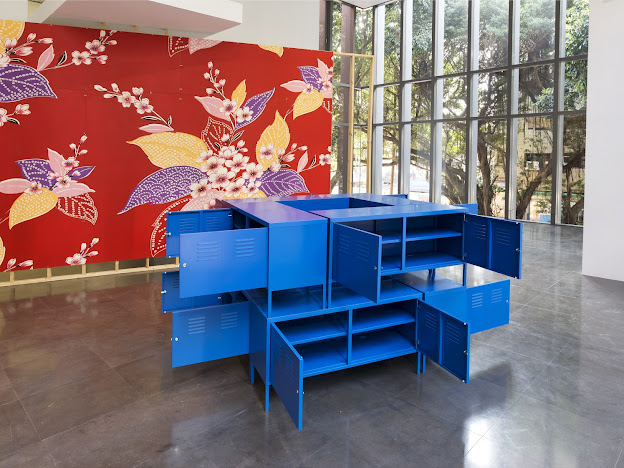
After Richard Lin (IKEA PS), IKEA PSx8, On the Passage of Few Persons through a Brief Moment in Time, MoNUTE, 2021. Courtesy of MoNUTE
More than any other single source, this little-known myth, narrated below, has given the notion of care in shaping Dasein, being-in-the-world as Heidegger’s ontology. As Cura was crossing a river, she thoughtfully picked up some mud and began to fashion a human being. While she was mediating on what she had done, Jupiter came along and gave the human form a spirit. Tellus (the Earth) provided the material for the human. Cura, Jupiter and Tellus argue about who should the human be named after. They requested Saturn to be the judge, and Saturn announced the verdict, “Jupiter, having given its spirit, you should receive that spirit at death; and since you, Earth, have given its body, you shall receive its body. But since Care first shaped this creature, she shall possess it as long as it lives. And because there is a dispute among you as to its name, let it be called homo, for it is made out of humus (earth).” 12
Heidegger brings care together with the ontological dimension of being, an authentic way of being in the living, instead of in the lived, as the myth emphasizes the spatial temporal setting of the human. Heidegger writes by directly pointing to the myth,
The rich connotations from the myth of Cura and Heidegger’s reading can be regarded not only as the metaphysical truth, but also as the curatorial one. It provides a genealogy of care in light of which to rethink the value of care in exhibition. As care is giving the form before assigning any purpose-ness, Jupiter’s spirit of homos, care provides an autonomous aesthetic experience. It is Care that was “meditating” on the pure human form, which could have been tossed back to the humus. Care is always associated with a crisis in creating an authentic ontological dimension, the self-consciousness in bringing forth the foremost possibility for all possibilities of life. For the curatorial, it is care that forms the consciousness, which unites the objective world and the inner subjectivity together, in order to make free exhibition decisions and commitments in facing a crisis of art. The curatorial gives form and devotion to the living. In care is embodied the ontological dimension of exhibition-making, almost as Heidegger’s explication of being-in-the-world as being-in-the-exhibition:
The multiplicity of these (being-in) is indicated by the following examples: having to do with something, producing something, attending to something and looking after it, making use of something, giving something up and letting it go, undertaking, accomplishing, evincing, interrogating, considering, discussing, determining…. All these kind ways of Being-in have care as their kind of Being.
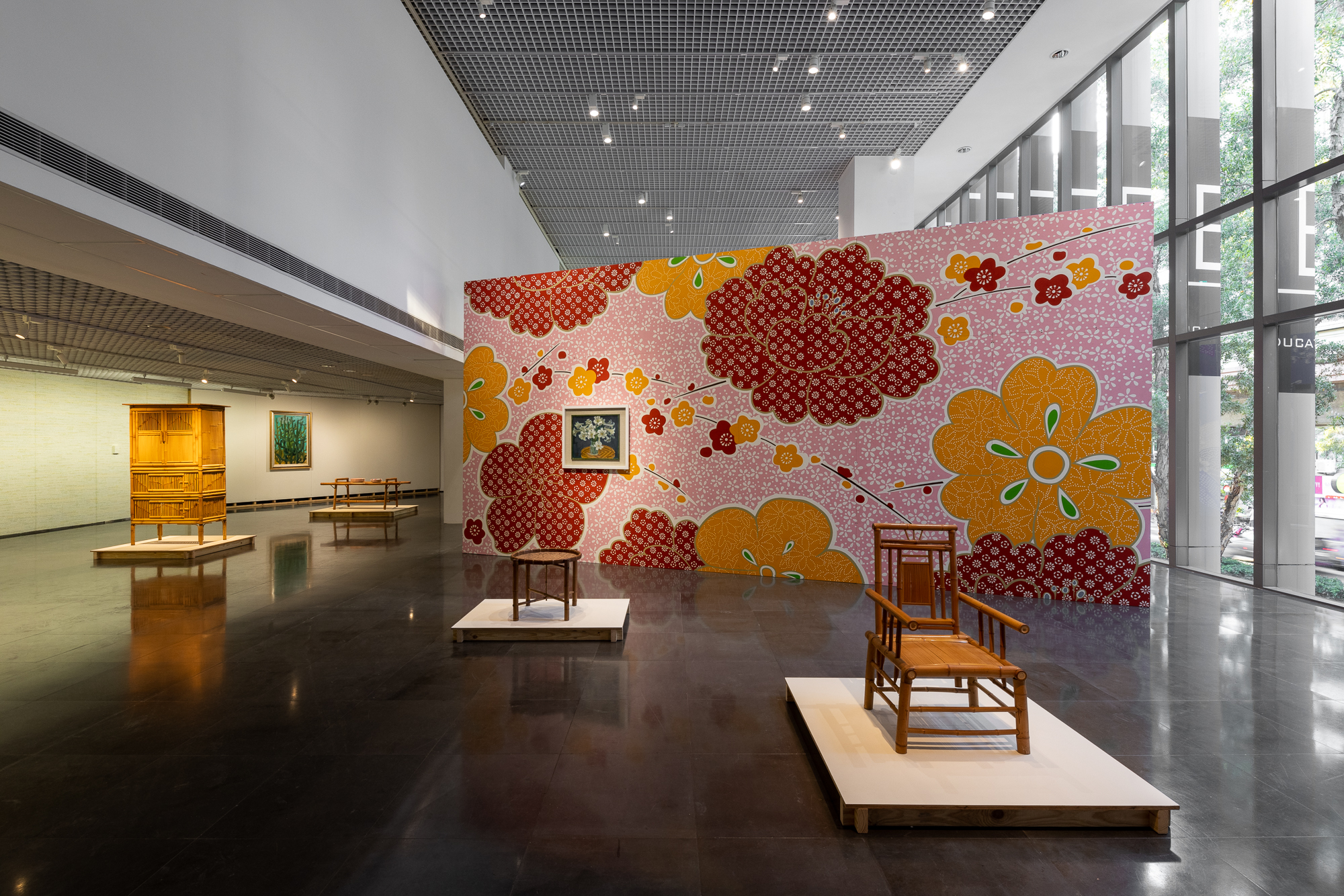
Installation view On the Passage of Few Persons through a Brief Moment in Time, MoNUTE, 2021. Photo by Chang Guo yao.
I would take some risk in interpreting some exhibitions in relation to the curatorial thing, which serves as the unapproachable structure of thing-in-itself of exhibition. One is the well-known remake of the legendary exhibition—When Attitudes Become Form curated by Szeeman in Bern, 1969—by Germano Celan, Venice, 2012. The remake version in a seemingly tautological curation moved beyond the notion of repetition and difference, creating a framing device for a history of the exhibition, the tradition of the independent curating, the material as conceptual base for making art and its display, and the various attributes of spectatorship involved. In probing the reflexive dimension of exhibition, the remake version has exceeded the original one by inviting the beholder to contemplate what an exhibition can be and cannot be. The other is the recent exhibition On the Passage of a Few Persons through a Brief Moment in Time in Taipei, curated by a collective of artists Michael Lin, and curators Jau Lan, Guo and Lee Ambrozy. Mixing and merging minimalist paintings, post conceptualist installation, folk art, and Ikea furniture, the exhibition fabricated the scenario of the global traffic from the modern art of Greenberg’s flatness to the post–Fordism industry’s flat packaging. Michal Lin’s flowery pattern was installed as backdrop for hanging the impressionist painting of flower done by Yen, Shui Long, a pioneer painter in the early 20th century, with his design of bamboo chairs of Asian Bauhaus style. Therefore the production of artistic knowledge in the context of post-coloniality was highlighted, and not to mention the exhibition title is a situationist détournement from the work of Guy Debord. Upon the exhibition’s installation, the possible structural cause of global art production can be speculated. Both exhibitions embodied care as the spatial-temporal dimension reveals itself in terms of the politics involved in the installation form, of which, I believe, the possibilities of the curatorial are many, even though we cannot guarantee that it can always succeed.
Share
Author
Hongjohn Lin is an artist, writer and curator. Graduated from New York University in Arts and Humanities with Ph.D. He has participated in exhibitions including Taipei Biennial(2004), the Manchester Asian Triennial 2008, the Rotterdam Film Festival 2008, and the 2012 Taipei Biennial, Guangzhou Triennial (2015), and China Asia Biennial (2014). Lin was curator of the Taiwan Pavilion Atopia, Venice Biennial 2007, co-curator of 2010 Taipei Biennial (with Tirdad Zolghadr), and numerous curatorial projects such as Taizhong’s The Good Place (2002) and Live Ammo (2012). Lin is serving as Professor at the Taipei National University of the Arts. For the past 10 years, he has been working on project based on George Psalmanazar, A fake Taiwanese in the early Enlightenment. He is interested in transdisciplinary arts, politics of aesthetics, and curating. His writings can be found in Artco magazine, Yishu magazine, international journals, and publications of Art as a Thinking Process (2010), Artistic Research (2012), Experimental Aesthetic(2014), Altering Archive: The Politics of Memory in Sinophone Cinemas and Image Culture (2017). He wrote the Introductions for Chinese edition of Art Power (Boris Groys) and Artificial Hells (Clair Bishop) . His books in Chinese include Poetics of Curating (2018), Beyond the Boundary: Interdisciplinary Arts in Taiwan, Writings on Locality, Curating Subjects: Practices of Contemporary Exhibitions.