


Curatorial Culture
Ethics is the inquiry about “how to live,” or about “how to live a good life” from the perspective of ancient Greek philosophy. It is also about the acceptable and unacceptable, compliance and contempt, what we should and should not do; and, more importantly, it is about the relationship between the individual and the other. Ethics shapes our emotional response to people and things, and determines what glory, shame, anger, and gratitude are, as well as what the inexcusable and unforgivable are. Ethics gives us “standards,” or “norms”—guidelines for behavior that emphasize “what ought to be” (of feelings and behavior) rather than “what is”. Ethics involves the combination of emotional insight and logical insight to help us make the right choices in our everyday lives. It’s an attempt to make reasonable decisions while taking the positions of others into account, which is exactly the situation a curator always confronts.
Following this line, the ethics of curating is supposedly neither discovered nor created as a disciplinary knowledge but was always already there. In the same way, humans have been confronted with ethical issues in everyday life likely all along the evolutionary history of homo sapiens, so to seriously think of it as a discipline and separate phenomenon arrived relatively late. Human conduct is pervaded by the ethical dimension everywhere and it is not only the questions for academic philosophers to ask, “How should I live?” “What is a good life?” or “What sort of person should one be?” Ethical issues are related to everyman, and there is of course no exception for curators. To investigate the ethics of curating is thus no less crucial to inquire about the essence of curation itself.
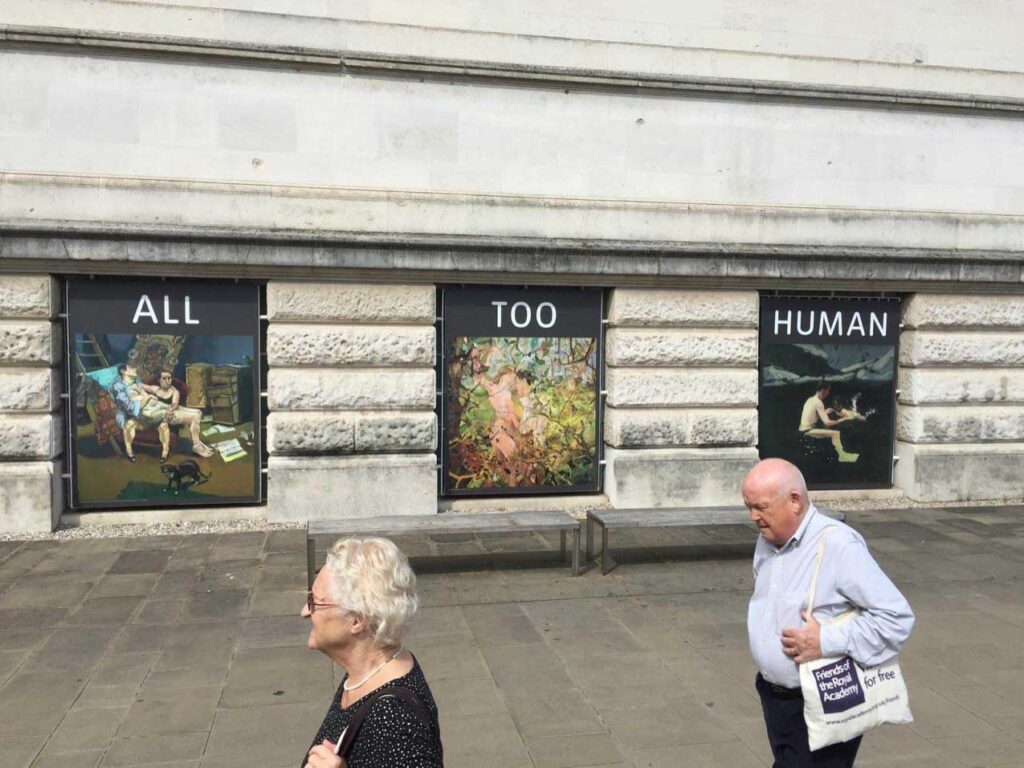
Posters of exhibition All Too Human, Tate Britain 2018. (Photo:Meng-Shi Chen)
Despite the museum exhibition, it is anthropology as a discipline itself along with ethnographic methods to be questioned as there is much on-going discussion and skepticism about how speaking for others is possible. As Trinh T. Minh-ha points out, anthropology is mainly a conversation of ‘us’ with ‘us’ about ‘them,’ of the white man with the white man about the primitive- nature man … in which ‘them’ is silenced. ‘Them’ always stands on the other side of the hill, naked and speechless. . . ‘them’ is only admitted among ‘us,’ the discussing subjects, when accompanied or introduced by an ‘us’. . . .4
3 Mary Elizabeth King. “Curators: Ethics and Obligations,” Curator: The Museum Journal 23(1):10-18.
Speaking for others is always the pivotal and challenging issue that modern-day anthropology and ethnography confront. The critical question posed by the curator Manray Hsu in the workshop of “Curators Intensive Taipei 19” discussing his curatorial project — When Kacalisian Culture Meets the Vertical City: Contemporary Art from Greater Sandimen — very well represents this self-awareness of the tension between the indigenous and non-indigenous people and cultures:
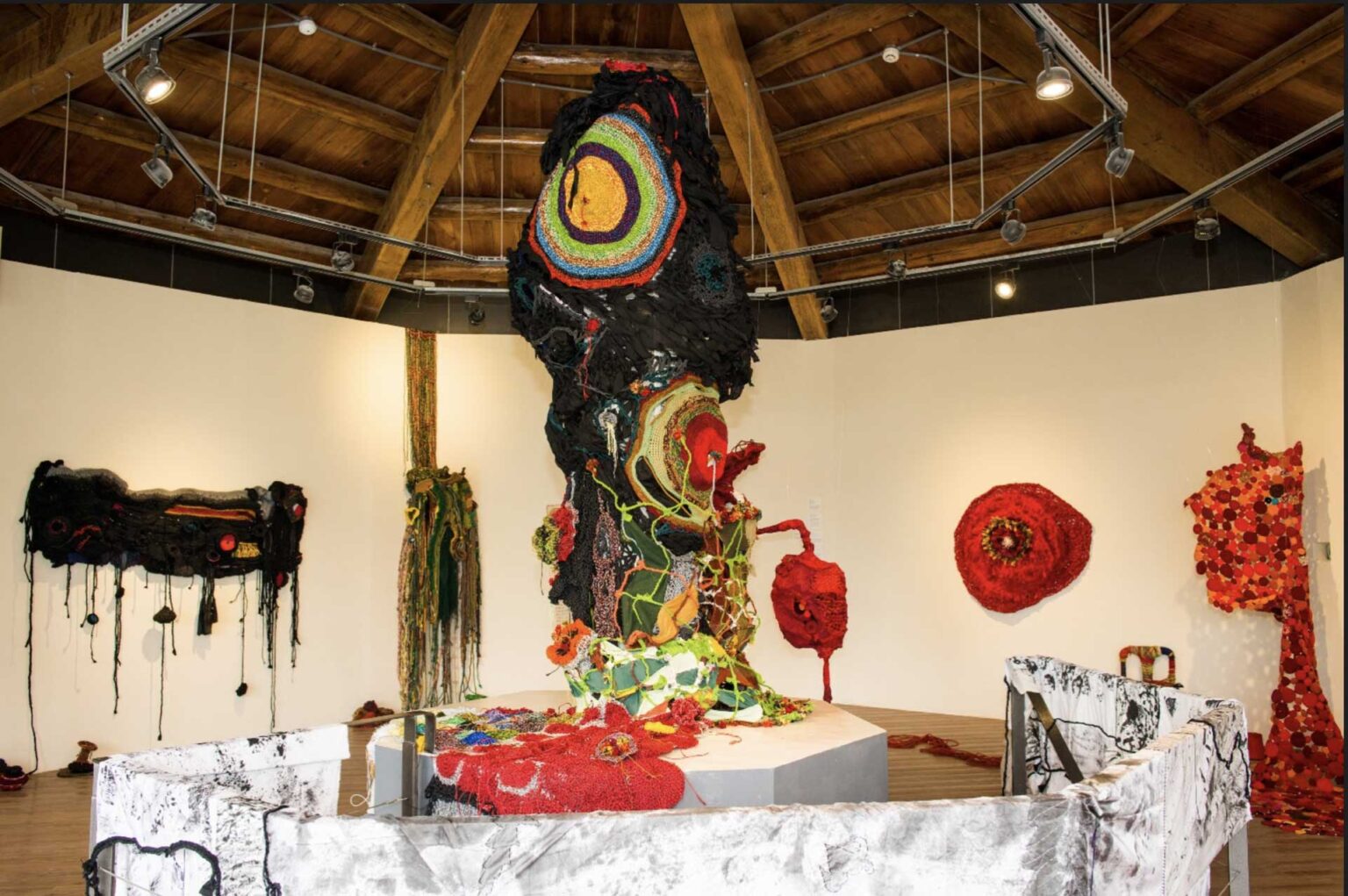
Yu-Ling Wu’s work at exhibition When Kacalisian Culture Meets the Vertical City: Contemporary Art from Greater Sandimen, 2019. (Photo:Manray Hsu)
The self-reflective question asked by Hsu is undoubtedly the question of the ethics of curating, urging us to realize its complexity as an epistemological web covering at least from art, anthropology, history, to philosophy. How do we define and interpret the other’s culture? More specifically, who has the authority to speak for any group’s identity and authenticity? What are the essential elements and boundaries of a culture? How does self contend with the other in inter-ethnic relations? Despite Hsu’s pensive question, these are familiar questions posed by some cultural anthropologists with critical insight such as James Clifford who developed the innovative ethnographic methods toward the anthropological and ethnological studies of the other (especially indigenous people), which meanwhile lead to the requirement of correspondent code of ethics for museum exhibition. Before the awareness of the dilemma of presenting and interpreting other cultures, the “principle” ethical concern for the museum curators is likely how to abide by museums’ code of ethics determined by the scholarly and professional organization (such as the association of museums), including the list of responsibility and duties on governance, collections, programs, and promulgation, etc. But now, with the awareness of asymmetrical power relations and cultural incommensurability brought about by some cultural anthropologists’ self-critique, to avoid this “ethnocentric trap” when attempting to present and interpret the cultural heritages of non-western peoples has become the crucial ethical concern for museums.

Sakuliu Pavavaljung’s work at exhibition When Kacalisian Culture Meets the Vertical City: Contemporary Art from Greater Sandimen, 2019. (Photo:Manray Hsu)
To ask “What is ethics of curating” is to ask “What is a curator?”, and to ask “What is a curator?” is to ask “What kind of person do I want to be?” as Mark Hutchinson brilliantly puts it:
6 Mary Elizabeth King. “Curators: Ethics and Obligations,” in Curator: The Museum Journal, 23(1):14.
8 Klenk, Michael. “Moral Philosophy and the ‘Ethical Turn’ in Anthropology” ZEMO 2, 331–353 (2019). https://doi.org/10.1007/s42048-019-00040-9
10 Mark Hutchinson. “On Expertise, Curation & the Possibility of the Public”. Seconds 2006. http: //www.slashseconds.org/issues/001/003/articles/mhutchinsondbeech/index.php
11 When asked about the curatorial mission and experiences at the place not where she is from, Zoe Butt replied as follows: “…I left the museum thinking: ‘I have the formulas’, then I realized after moving to Asia that they don’t work. I was, and still am, in the process of unlearning all of those institutional expectations, terminologies, and approaches, because living in Vietnam has shown me more proactive and provocative means of getting things done. This empowered me to speak back to the artworld.” Are biennials ‘curatorial mission impossible’? Ahead of the Sharjah Biennial, co-curator Zoe Butt pauses to reflect. https://www.artbasel.com/news/zoe-butt-interview-sharjah-biennial-chris-sharp-lulu
12 How the ethics of curating can be linked with Derrida’s notion of hospitality is inspired by the curator Francis Maravillas’s presentation on “Guess Who’s Coming to Dinner: Food and Hospitality in Contemporary Art and Exhibitions in Asia and Beyond” at the workshop of “Curators’ Intensive Taipei 19”. https://curatorsintensive.tw/francis-maravillas/?lang=en
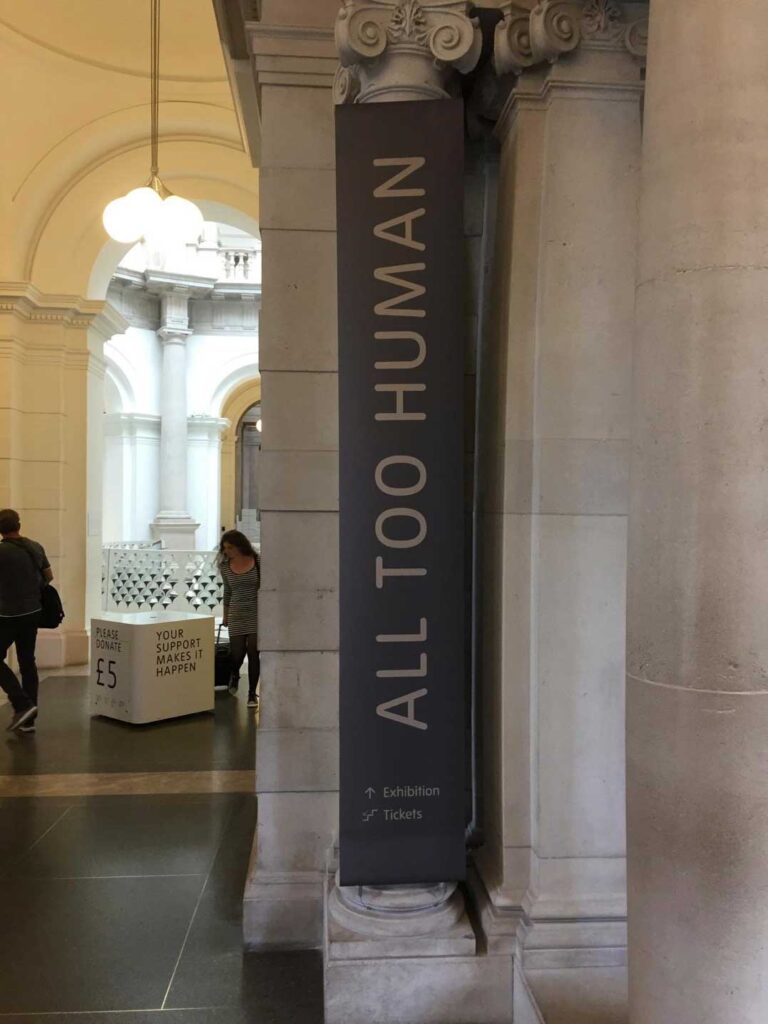
Exhibition All Too Human, Tate Britain 2018. (Photo:Meng-Shi Chen)
There is nonetheless an inevitable tension arising in hospitality as ethics in the Derridean sense. In order to be hospitable, the host must rid himself of security and invite the new arrival. The self must give up authority, security, and property and promises benevolence; and the guest becomes the host. That said, absolute, and hence unconditional, hospitality is never possible in conjunction with indivisible sovereignty. The authority of the host has diminished, and the host inevitably becomes the guest and vice versa:
To grasp the ethics of curating through hospitality is therefore not inconceivable after formal regulations and obligation is put into question and lead to the indeterminacy for the complicated and sophisticated ethical concerns of curators, not to say that the displacement of host/guest in hospitality as the relationship between one/other is always the curators’ principal ethical concern.
Following this general distinction, if there is no agreement between the others and us, there is hardly any sympathy. Yet, even if there is agreement, we are likely to be preoccupied with the assumed duality between our emotions and the emotions of the others, for our attention is focused on the analogy between the others and us. In other words, sympathetic emotions can never be qualified as the source of ethics of hospitality in which we lose consciousness as self.